Breaker Trips Every Time the AC Starts? What's Drawing Too Much Power
Quick Answer: Your air conditioner draws a brief, heavy surge of electrical current the instant its compressor motor starts, several times higher than the current it uses while running. That surge is normal. A breaker that trips during it usually means something is pushing the surge higher than the compressor was built for: a weakening start capacitor, restricted airflow from dirty coils or a clogged filter, a fan or compressor motor dragging on worn bearings, or a wiring connection that's loosened or corroded. In South Florida's heat and salt air, capacitors and electrical connections wear out faster than they would in a drier climate, which is a big reason startup trips show up so often here. Repeated tripping is a signal to have a technician measure the actual amp draw rather than resetting the breaker and hoping it holds.
The Moment the Compressor Kicks On
You've heard it before. The thermostat calls for cooling, the outdoor unit hums for a split second, and then the whole system goes dark along with the breaker panel. You reset it. The AC runs fine for a minute, or an hour, then it happens again.
It rarely trips while the system is already running steady. It trips right at ignition, the moment the compressor motor has to overcome its own resting inertia and start spinning. That timing detail matters more than it seems. A breaker that trips specifically at startup, rather than at random points during a long run cycle, points to a startup-specific cause rather than a general overload. Understanding what happens electrically in that first second is the fastest way to narrow down what's actually failing.
Why Every Compressor Needs a Power Surge to Start
A compressor motor sitting still has almost no resistance to the current trying to flow through its windings. For that first fraction of a second, before the rotor begins turning, the motor behaves less like a motor and more like a dead short. It pulls a current spike electricians call locked rotor amps, or LRA. Once the rotor starts spinning and builds momentum, the motor generates its own opposing voltage that limits current flow, and the draw settles down to normal running amperage within a second or two.
Every compressor carries a specific LRA rating, and the breaker protecting that circuit is sized with a short delay built in specifically so it can ride through that momentary spike without tripping. When the
breaker trips right at that instant instead of holding through it, the actual current draw exceeded what the breaker and the compressor's design margin were built to tolerate. Something added extra resistance, or extra load, to a start sequence that was already working close to its limit.
The Usual Suspect: A Weakening Start or Run Capacitor
The capacitor's job is to give the compressor motor a timed jolt of extra energy right at startup, helping the rotor overcome inertia faster so the current spike is shorter and less severe. Capacitors are filled with an electrolytic material that dries out and loses capacity over years of heat cycling. Florida's combination of high ambient heat and near-constant humidity speeds that breakdown up compared to drier parts of the country.
A capacitor that's lost even twenty to thirty percent of its rated microfarad capacity can't deliver that assist fast enough. The compressor lingers in its high-draw locked rotor state a beat longer than it should, and that extended surge is often exactly what pushes a marginal breaker over the edge. A technician checks this with a capacitor tester or a multimeter set to capacitance, comparing the reading against the rating printed on the capacitor's case. A reading that's drifted well outside that tolerance confirms the part is on its way out, even if it hasn't failed completely yet.
Tip:
A capacitor that's visibly domed, bulging, or leaking oily residue on top has already failed internally, even if the AC still starts on some cycles. That bulge is pressure building from the breakdown happening inside, and it's a reliable visual cue a technician looks for before ever touching a meter.
When Airflow Restriction Raises the Load
A compressor doesn't work in isolation. It's moving refrigerant against pressure created by the whole system, and anything that restricts airflow across the indoor coil or the outdoor condenser coil makes the compressor work harder to hold that pressure differential from the moment it starts. A filter that's gone months without changing, or an outdoor condenser coil caked with dust, pollen, and the fine grit that collects on coastal units, forces the system to fight for airflow it isn't getting.
Energy efficiency researchers have documented that a sufficiently dirty filter measurably raises the electrical load a cooling system pulls to do the same amount of work. That increased load doesn't wait until the system settles into steady operation. It's there from the first second the compressor engages, stacking on top of the normal startup surge.
Homeowners tend to associate a dirty filter with weak airflow out of the vents, not with electrical trips at the breaker panel. But the two connect through the same physical principle. Restricted airflow means higher head pressure, and higher head pressure means the compressor motor has to work against more resistance the instant it starts turning.
Fan Motor Drag and Worn Bearings
The outdoor condenser fan and the compressor typically share a run capacitor and, in many residential systems, share the same circuit protection. A fan motor with bearings that have worn down or dried out spins with added mechanical resistance. An electric motor fighting mechanical drag pulls more current to overcome it, the same principle as a car engine working harder against a dragging brake.
If the fan motor is struggling at the same moment the compressor is already drawing its peak locked rotor current, the combined draw on that circuit can tip a marginal breaker even when either component alone would have been fine. A technician isolates this by running an amp clamp meter on the fan motor circuit independently of the compressor, watching whether the fan's draw sits above its rated full-load amperage once it's spinning freely. A motor that hums, spins slowly, or won't turn at all when nudged by hand is usually well past the point of contributing to nuisance trips. It needs replacing outright.
Wiring, Connections, and Corrosion in a Salt-Air Climate
Every connection point in the electrical path carries a small amount of resistance: the disconnect box outside the unit, the contactor terminals, the wire lugs at the compressor itself. A connection that's loosened over time, or corroded from humidity and salt-laden coastal air, carries more resistance than it should. Higher resistance at a connection point generates heat and can distort the current pattern the breaker sees, sometimes causing a trip that has nothing to do with the compressor itself being at fault.
Coastal HVAC systems in South Florida see this more often than inland units. Airborne salt speeds up oxidation on copper and aluminum contacts, and it tends to show up first at the outdoor disconnect and contactor, the components most exposed to the outside air.
Warning: Repeatedly resetting a breaker that keeps tripping, without having the actual cause diagnosed, lets a developing electrical fault keep drawing excess current through a connection or winding that's already compromised. Each reset is effectively another full-current startup surge running through whatever weak point caused the trip in the first place. That repetition is how a marginal problem turns into a failed compressor or a scorched connection.
What a Technician Actually Checks During a Startup Trip Call
The diagnostic sequence for a startup trip call usually starts with an amp clamp meter on the compressor's common wire, capturing the actual peak draw during a live start attempt and comparing it against the nameplate LRA rating. From there the capacitor gets tested for microfarad value against its rating, and the contactor points get inspected for pitting or arcing damage. The compressor's winding resistance gets measured to rule out an internal short or a winding beginning to ground out against the compressor shell. Airflow gets checked at both coils. The breaker itself gets inspected too, since breakers can weaken over years of thermal cycling and start tripping below their rated threshold even when everything downstream is healthy.
More than one of these issues often shows up together. A capacitor that's been quietly weakening for a year puts extra strain on the compressor motor, and that extra strain speeds up wear on the same motor's bearings and windings. A technician who only replaces the capacitor without checking the rest of the circuit sometimes sees the trip come back within weeks.
Commercial Package Units and Multi-Zone Systems
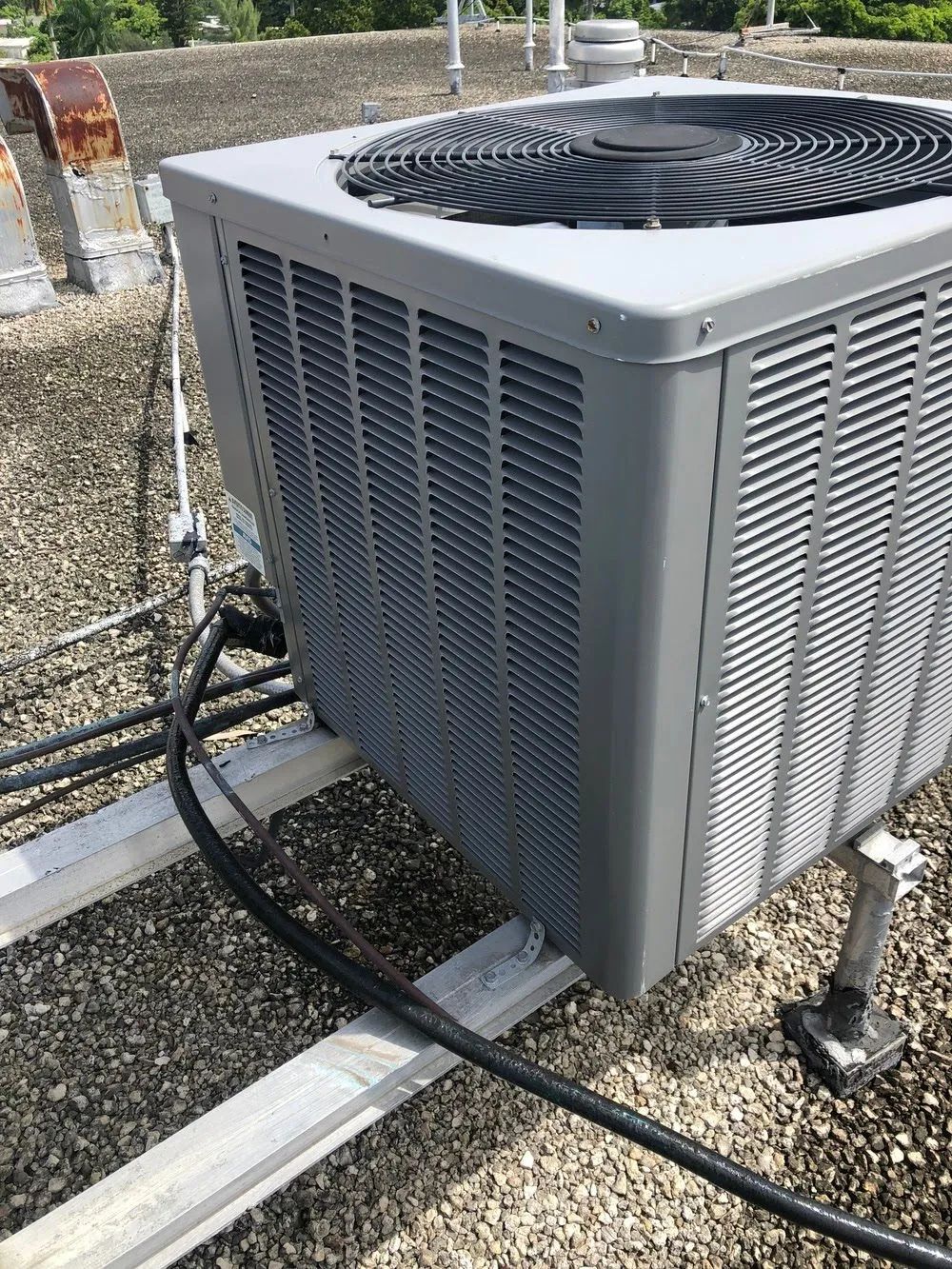
Commercial rooftop units and package units run larger compressors with correspondingly higher locked rotor amp ratings. Many are wired with dedicated starting components, hard start kits or soft-start modules, built in specifically because larger motors produce a more severe locked rotor spike. A startup trip on a commercial RTU often points to the same capacitor, contactor, or airflow issues found in residential systems, just at a larger electrical scale.
Building owners running multiple rooftop units on a shared electrical panel sometimes see trips that turn out to be a sequencing issue, with two large compressors happening to start within the same moment and stacking their surges on a panel that wasn't sized for simultaneous starts.
Ductless mini-split and multi-zone systems behave differently. Most use inverter-driven compressors that ramp speed up gradually rather than jumping straight to full load, which produces a much gentler startup current curve. A mini-split that trips a breaker at startup is a less common, often more serious sign. It frequently points to a fault in the inverter board or outdoor unit wiring rather than the mechanical wear patterns typical of a conventional compressor.
Frequently Asked Questions
Is it safe to just keep resetting the breaker if the AC eventually starts?
Resetting it once to confirm the trip is real is fine, but repeated resetting without a diagnosis isn't safe long-term. Each reset sends another startup surge through the struggling component, often turning a fixable issue.
Why does my AC only trip the breaker in summer and not other times of year?
Higher ambient heat forces the compressor to work against more pressure moving heat outdoors, which raises both running load and startup surge severity. A marginal capacitor or connection often fails once summer heat fully arrives.
Can a hard start kit fix a breaker that trips on startup?
Sometimes, temporarily. A hard start kit adds starting torque, shortening the locked rotor phase and easing surge severity. It helps some compressors, but doesn't replace diagnosing the cause, since it can mask a failing capacitor.
Could the breaker itself be the problem instead of the AC?
Yes. Breakers weaken with age and thermal cycling, and one that's been tripped often can start triggering below its rated threshold. A technician can test the breaker's trip point to rule this in or out.
Does this happen with both residential and commercial systems?
The same principle applies to both: a startup surge exceeding what the circuit can handle. Commercial units and RTUs face it at a larger scale, often sequencing multiple compressors. Residential systems trace to one weak capacitor.
Getting the Diagnosis Right the First Time
A breaker that trips the moment your AC tries to start is telling you something specific about that first second of operation, not delivering a vague warning about the system as a whole. The difference between a fifteen-minute capacitor swap and a compressor replacement usually comes down to catching the pattern early and having someone measure the actual current draw instead of guessing at the cause. America's Technical Service, Inc. has spent over 20
years tracing exactly this kind of startup electrical fault across homes and businesses in Fort Lauderdale, FL and throughout South Florida, where heat and salt air put extra strain on the components most likely to cause it. If your AC has been tripping the breaker at startup, reach out to schedule a diagnostic visit so a certified technician can trace the surge back to its actual source before it turns into a bigger repair.